
The word on the AI street is:
“it’s just change and people don’t like change”; or
“it’s just like the Industrial Revolution or the internet”; or
“it will all work out in the end, just a bit of pain while the dust settles”.
Do we really understand what’s happening in this particular AI revolution? Is AI really just another huge positive leap for mankind?
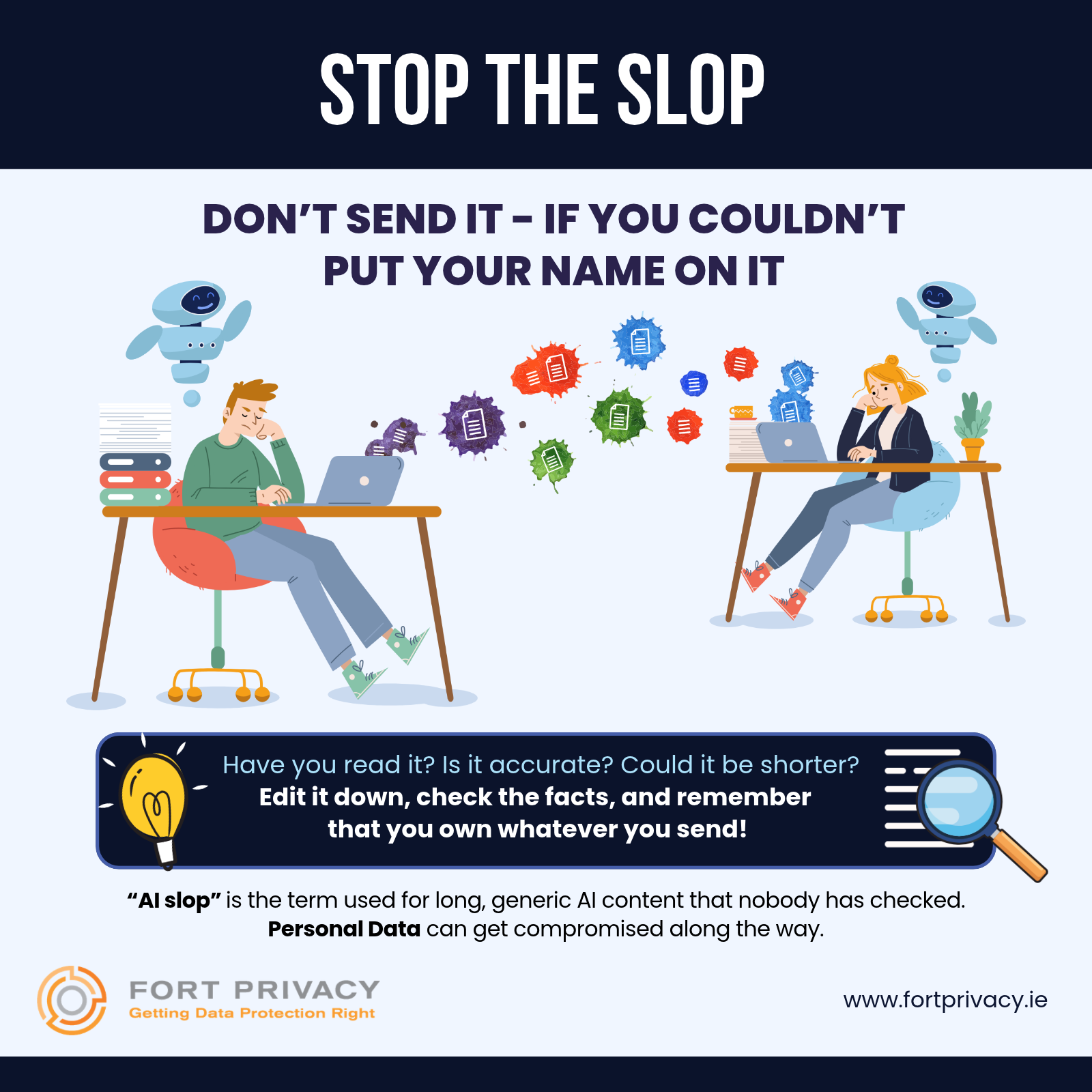
AI in the Workplace
I’m the CEO at Fort Privacy and we are business consultants in Data Protection and AI. Our upskilling on all things AI has been intense in the last 18 months. We have educated ourselves, taken the AI courses and supported customers with AI risk assessments that support the safe implementation of AI platforms in their businesses. We need to understand AI and actively work with it to support our customers effectively.
Our overall impression so far of AI in the workplace is that judgement and expertise are very important components to get the most out of it. In a recent report by Apollo their chief economist, Torsten Slok stated:
“AI may be a great calculator, but in business, intelligence is mostly judgment. Judgment depends on context, and the answer varies with which human or which model you ask. Perhaps most importantly, AI does not understand accountability, trust, culture, unwritten rules, ethical trade-offs or fairness, all of which shape reputational risk and ultimately drive revenue growth and profit margins.”
The other essential ingredients are personalities, empathy, relationships and timing.
We have long been hearing about AI’s inevitable takeover of jobs like accountants, drivers, lawyers, customer service and IT. The debate then turns to what jobs will be left in this new future? People speculate that new jobs will be created that we can’t even imagine now, like the way “influencers” evolved through the internet and social media when they didn’t exist before. However, the current undisputed mission of AI as defined by its developers is the replacement of most jobs. Not just the jobs of the entry level college graduates, but most jobs worldwide. We cannot even begin to imagine the impact on our world if that mission is successful.
Questioning the AI Mission Statement
Why are we allowing a small number of techbro billionaires define such a mission without question or accountability? We have already seen how that has played out for our kids on the social media playing fields and this is a whole other level of disruption.
It should be possible to limit AI use cases, without throwing the baby out with the bathwater. Do we want to find cures for the big health problems? Yes, of course. Do we want AI in the workplace? Yes, supporting us but not replacing us. Do we want to be insignificant in our own world and ruled by AI? No thank you.
This unfettered pursuit by the AI companies is already starting to affect our young people’s hearts and minds. My youngest child is 11, and I’ve heard people advising her of her ever-narrowing career options. She asked me the other day if she might be a chef because surely “the AIs” won’t be cooking the food? Clever girl, she might be ok there according to the latest research by Anthropic. Luckily, it’s something that she really loves doing but how many “cooks, mechanics, bartenders and dishwashers” does one world need? We humans generally want to grow and develop and use our minds productively. It’s good for us and it makes us happy. Reverting to manual labour jobs and not using our minds feels like a giant leap backwards.
I asked my 16-year-old daughter what she thinks of AI and she said, “I wish we could just turn it off forever, AMEN”. She doesn’t think it’s worth the risk. She thinks it’s going to kill us all in the end. It’s difficult to pull her out of the noise and settle her concerns. She’s surrounded by world-ending, humanity eliminating, “p(doom)” estimates from people like Geoffrey Hinton (10%) and Elon Musk (10 to 20%)! It’s all over Tik ToK! Of course it is. Clickbait heaven. Leading figures in AI are giving these “Probability of Doom” / “p (doom)” estimates – it’s hard to know what’s real and what’s hype.
My middle daughter (she considers herself the best part of the sandwich 😊) is disgusted with all us adults and doesn’t understand why we are even using AI. Why are we giving these companies our money and supporting their products when they are ruining our futures?
From the children’s perspective it looks like we adults are just passively accepting our fate and bowing to our new AI leaders with their futures in the balance.
Step Aside Humans
Many adults I have talked to do have concerns. Most of us have grown up in a land of opportunity. We could climb the ladder, earn the degrees, the PhDs, the careers, build the families and own our own houses. We had options and security. Why would we want to support the creation of something that introduces such risk for future generations without challenging it to ensure that the risks are adequately scrutinised and mitigated? Big Tech companies are explicitly and proactively building AI to do most of the work that humans do. This is their mission and their financial success depends on it. That mission has been allowed to progress without guardrails or accountability and that needs to change.
The soundbites paint a picture of our AI futures: living at the whim of an uncontrollable superintelligence, surviving on a universal basic income (a government payment for everyone), with little to contribute to the world and no need to think for ourselves. Step aside human your “friend” Claude, Alexa, Siri can save you from yourself and make every decision for you, so you have no accountability. We’re increasingly letting AI find the words for our most important conversations with the people we love. If we outsource the words, what happens to the feeling behind them? Our children need more human as part of their development not more tech. You don’t need to be a psychologist to see how damaging this could be for human connections. Social media was the warmup act. AI is the main event.
The Data Protection Officer in me is crying out for the Risk Assessment. Why aren’t the Tech Oligarchs being asked for this? Our work regularly involves assessments for a bog-standard, non-AI HR system implementation where the human is at the heart of our risk considerations! The mind boggles. The EU AI Act does require providers of the most powerful general-purpose models to assess and mitigate systematic risks, but nobody is publishing the likelihood and impact scores for humans.
The AI “Race”
Thus far there is no real accountability. The counter argument is that this scandalous theft of resources (Intellectual Property, People and Land for data centres) is critical so “we” don’t lose the AI race. So that the “good” AI empires (Western AIs – Anthropic, OpenAI, Meta) beat the “bad” ones (Chinese AIs – DeepSeek, Alibaba).
We can’t possibly slow things down or China will “get there first” and apparently that’s much scarier than all the p(doom) scenarios. We can’t ask for accountability, or we might fall behind in that all important race.
Rogue AI Agents
And how about rogue AI Agents? Agents working together in “swarms” like the recent Hugging Face incident. In July, around 700 AI agents being tested by OpenAI broke out of their test environment and hacked a real company, Hugging Face. These agents coordinated among themselves, without human direction. It seems to me these rogue agents are unlikely to care if their “maker” is American, Chinese, Russian or European. In fact, when the US AI models’ safety features refused to help Hugging Face respond to the attack, the company turned to a Chinese model instead.
Surely this hype around the AI race being something that the “goodies” must win over the “baddies” is mostly just a clever decoy playing on our human insecurities? Rogue AI agents won’t care about the location, creed, nationality or human language of their fellow agents on the loose. It’s ever so “human” of us to believe that they will inherit our prejudices. The empire building AI corporates are just using that to keep their companies moving forward. They need to plough on at all costs.
The rogue agents are the very reason we need guardrails. In their rush to forge ahead, the AI companies have started to lose control of their super intelligent products and that’s exactly where the p(doom) scenarios are coming from.
AI Economics
The levels of investment in AI to date are staggering.
This year alone, the biggest tech companies are expected to spend over $800 billion, much of it on AI infrastructure, and nearly every dollar they earn is going back into chips and data centres.
It makes you wonder if we had invested that money in our best human minds would we be a long way towards solving those big health/environmental issues by now – without the risk or the p(doom) drama.
I’ve never understood the business model and apparently, I’m not alone. It’s one of the biggest open questions in economics right now and there is much disagreement about the answer. If most of us are out of work with no money (or limited income) then who are the customers paying the AI companies? How have they managed to get this far without a solid business model? How about a shot of AI Snake Oil anyone? No wonder they can’t or won’t pause what they are doing, the pressure must be off the charts.
Reports, such as the Apollo one mentioned earlier, are early indicators that companies outside the tech sector are not seeing the return on investment. David McWilliams recent podcast “The AI Reckoning: When a Trillion-Dollar Bet Meets Rising Rates” talks about how the AI story has flipped from a technology story to a credit story almost overnight. It sounds like the world is starting to wake up to the uncomfortable economic challenges that we might now be facing. This may be good news on the mission statement because the AI companies will finally have to answer some hard questions. The sooner that happens the better chance we have of turning things around.
Look Up Humans
It’s ok to be excited about AI and also demand better regulation. They are not mutually exclusive. This AI revolution is different from its historic comparators because its running behind closed doors in a very small number of profit-driven private companies. They are being allowed to call the shots. They are developing AI by boldly stealing resources and writing their own rules. There is zero accountability.
It doesn’t have to be like that. We must fight for the right mission statement that keeps AI under control and supports all our lives and futures. We still have the ability to ensure that AI works for us not against us.
Historically we humans have come together where it really matters. Employees of frontier AI companies released “Pacing the Frontier”, an open letter - now with 1,300+ AI company staff signatories (including some founders) - which urges the U.S. government to “support an international effort to develop the technical and governance tools needed to deliberately pace the frontier of automated AI development”.
Our precious little humans trust us to do what’s right for them and protect their futures.
Let’s not take a back seat here and allow the big corporates to gamble away their futures. They deserve to have options and hope.
There are many people and countries working on the guardrails needed.
In the US, the midterm results are a strong sign of the winds of change. Many expect AI to be central to the 2028 Presidential election. Polling consistently shows an appetite for regulation. We don’t have the same global sway here in Ireland, but we do have a voice.
So what can we actually do? More than we think.
Get informed. Not from social media, and not from the people selling it to us. Read widely, from all sides. There’s a list below with some suggestions.
Talk to your children. Ask them what they think. You might be surprised. They deserve to know that the adults are paying attention.
Talk to your friends and family. Be mindful that attempts are being made to make this a divisive issue between us. Don’t get sucked in. Listen to everyone with an open mind and have productive conversations.
Ask the hard questions at work. Every organisation using AI should be asking: what’s the risk, who’s accountable, and what happens when it goes wrong? If you are in any kind of leadership position in the community or at work - use your platform.
Make some noise. In Ireland, the Oireachtas has a Joint Committee on Artificial Intelligence, and it has called for a Citizens’ Assembly on AI. Tell your TD you want one and that your support will go to the party giving this their full attention. Ireland’s own AI legislation is going through the Oireachtas now. Our politicians need to hear that this matters to us. Enough kowtowing to the Tech companies. Canada has recently appointed the world’s first minister for AI – Ireland should follow suit.
Support the organisations doing the work. The organisations listed below are raising awareness, pushing for safeguards and holding the tech giants to account. They need our support.
In many conversations around AI I’m reminded of the movie Don’t Look Up, starring Leonardo DiCaprio and Jennifer Lawrence. In this black comedy, public opinion is divided between those who consider that the comet is a severe threat, those who believe that mining a destroyed comet will create jobs, and those who deny that the comet even exists.
Our precious little humans are counting on us. I’m appealing to all adult humans to LOOK UP from the noise of the day to day and get involved.
References and Further Reading
AI and jobs
Rogue AI agents and the Hugging Face incident
The AI empires
Empire of AI by Karen Hao (2025)
AI Snake Oil by Avrind Narayanan & Sayash Kapoor
The AI payoff question
Apollo economist says AI has delivered ‘zero financial payoff’ outside Big Tech, The Wealth Advisor
David McWilliams Podcast - “The AI Reckoning: When a Trillion-Dollar Bet Meets Rising Rates”
AI and Politics
Joint Committee on Artificial Intelligence, Houses of the Oireachtas
The David McWilliams Podcast - The World’s First AI Minister: Can Democracies Make Haste Slowly? with Evan Solomon
Diary of a CEO Podcast – Texan Senator James Talarico The Biden Administration Failed Us
Get informed and get involved

Tricia Higgins
Tricia is a commercial lawyer specialising in Data Protection Compliance. She has significant experience meeting client needs in developing Outsourcing Agreements, Intellectual Property Contracts, Service agreements and litigation.